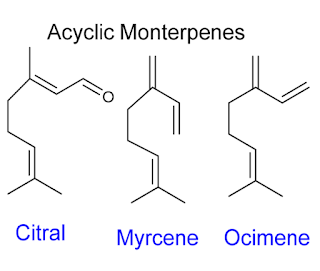
The term terpene, proposed by Dumas in 1866, originates from the Latin word ‘turpentine’ (Balsamum terebinthinae), a liquid extract from pine trees. Turpentine contains the "resin acids" and some hydrocarbons, which were originally referred to as terpenes. Traditionally, all natural compounds built up from isoprene subunits and for the most part originating from plants are denoted as terpenes.
Terpenes are the largest and most diverse group of plant secondary compounds and basically consist of five carbon isoprene units which are assembled to each other (many isoprene units) by thousands of ways. These compounds are classified as to the number of isoprene units, which include the hemiterpenes (1), monoterpenes (2), sesquiterpenes (3), diterpenes (4), sesterterpenes (5), triterpenes (6) and polyterpenes (many units).Terpenes are common in most plants and fungi, but they rarely accumulate in bacteria. The development of chromatographic and spectroscopic methodologies in 1945 propelled the explosive discovery of terpenoids and terpene-derived products. Terpenoidal molecules are antifungal, antimicrobial, antiviral, and antiparasitic.
Many flavorings and nice fragrances are consisting on terpenes because of its nice aroma. Conifer wood, balm trees, citrus fruits, coriander, eucalyptus, lavender, lemon grass, lilies, carnation, caraway, peppermint species, roses, rosemary, sage, thyme, violet and many other plants or parts of those (roots, rhizomes, stems, leaves, blossoms, fruits, seed) are well known to smell pleasantly, to taste spicy, or to exhibit specific pharmacological activities due to terpenes compound.
Some terpenes have high vapor content and are therefore classified as volatile (VTs), e.g., hemiterpenes, monoterpenes, and sesquiterpenes. Others are semi-volatile or non-volatile, such as diterpenes.
Terpenes
Food science is the study of food's composition, properties, and interactions with biological and chemical processes. It explores how food is processed, preserved, and safely consumed. By combining biology, chemistry, and nutrition, food science improves food quality, enhances flavor, and ensures safety for global consumption.
Sunday, December 12, 2021
The Most Popular Post
-
Anethole is primarily extracted from plants like anise, fennel, and star anise through various methods, with steam distillation and solvent...
-
Protein C and protein S are glycoproteins, predominantly synthesized in the liver, that are important components of the natural anticoagulan...
-
Solid/liquid extraction is sometimes called leaching. When the soluble component is incorporated in a liquid, liquid/liquid extraction may b...
-
Water in Food Preservation and Shelf Life Drying and freezing are common food preservation techniques. Foods are dehydrated or frozen the av...
-
Food contamination by various agents can result in over 250 distinct foodborne diseases, posing a significant public health and economic cha...