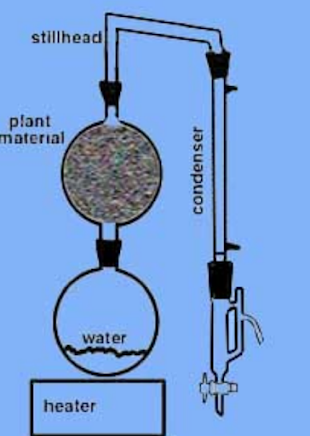
Steam distillation is a separation process used to purify or isolate temperature-sensitive materials. In steam distillation, dry steam is passed through the plant material. These vapors undergo condensation and collection in receivers.
The process of steam distillation separates the substances of a mixture through evaporation, which then involves condensing the vapor back into liquid, taking advantage of the fact that different elements or compounds have different boiling points. It is a method for separating miscible liquid base depending upon their volatilities.
Steam distillation is a widely utilized method for extraction of volatile constituents, especially in the case of using leaves and flowers as starting materials. Steam distillation is used for the isolation of antioxidant and antimicrobial compounds from herbs and species such as clove, rosemary, sage and thyme.
It has been in use for essential oil extraction for many years. Steam distillation are widely used in the manufacturing of essential oils, for instance perfumes. This method uses a plant material that consists of essential oils.
The advantage of steam distillation over simple distillation is that the lower boiling point reduces decomposition of temperature-sensitive compounds. Steam distillation is useful for the purification of organic compounds, although vacuum distillation is more common.
Extraction method - Steam distillation