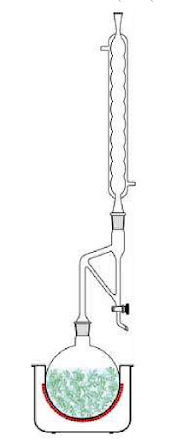
Essential oils from plant can be extracted by several methods which include hydro-distillation (typically using water or steam), solvent extraction, carbon dioxide extraction, cold pressing as well as florasol/phytol extraction. Hydro distillation and steam distillation are commonly used methods for the extraction of volatile oils.
Hydro distillation has long been used for the extraction of essential oils and bioactive compounds from plant materials. This is the simplest and usually the cheapest process of distillation. Hydro distillation seems to work best for powders and very tough materials like roots, wood, or nuts.
The equipment used for hydro-distillation is the Clevenger apparatus, which has a long tube, at the end of which the vapor is condensed and recovered.
The main advantages of this method are that less steam is used, shorter processing time and a higher oil yield.
In distillation, the aromatic plant material is packed in a still and a sufficient quantity of water is added and brought to a boil; alternatively, live steam is injected into the plant charge.
The heat and steam cause the cell structure of the plant material to burst and break down, thus, the essential oil is freed from the oil glands in the plant tissue.
The essential oil molecules and steam are carried along a pipe and channeled through a cooling tank, where they return to the liquid form and are collected in a vat.
The emerging liquid is a mixture of oil and water, and since essential oils are not water soluble they can be easily separated from the water. The vapor mixture of water and oil is condensed by indirect cooling with water. From the condenser, distillate flows into a separator, where oil separates automatically from the distillate water.
Hydro-distillation can be performed in three different ways.
1. Water distillation
2. Water and steam distillation
3. Direct steam distillation
Three main physicochemical processes involved in hydro-distillation are hydro-diffusion, hydrolysis, and decomposition by heat.
Hydro-distillation process of essential oil